Dubai’s Roads and Transport Authority announced that public transport, shared mobility and taxis carried approximately 348.1 million riders in the first half of 2026, with average daily ridership reaching nearly 1.9 million passengers. That figure covers the Dubai Metro, Dubai Tram, public buses, marine transport, taxis and shared mobility services including ride-hailing vehicles, hourly rentals and on-demand buses. Limousines carried an additional 5.7 million passengers across the same period. January was the busiest single month, recording 73.4 million passengers. These are not just transport statistics. They are a measure of how completely Dubai has transformed its relationship with public mobility over the past two decades, and a forward indicator of what the next phase of that transformation is going to look like.
The context behind the 348 million figure is as important as the number itself. In 2006, public transport and shared mobility accounted for just 6 per cent of total trips made in Dubai. By 2025 that share had risen to 22.3 per cent, and the RTA’s target is 25 per cent by 2030 in line with the Dubai Urban Plan 2040 and the D33 economic agenda. That shift from 6 per cent to 22 per cent over two decades in a city that was designed around the car represents one of the most significant urban mobility transformations in the modern history of the Middle East. The 348 million passengers carried in H1 2026 are the commercial and social expression of that transformation.
“These figures reflect the success of Dubai’s vision to build a world-class integrated transport system based on sustainability and innovation, making public transport the preferred mobility option for residents and visitors. This ecosystem is strengthening confidence in public transport and embedding a culture of sustainable mobility.”
— Mattar Al Tayer, Director General and Chairman, Dubai Roads and Transport Authority (UAE Media Office, August 2026)
The Dubai Metro Leads and Air Taxis Are Coming
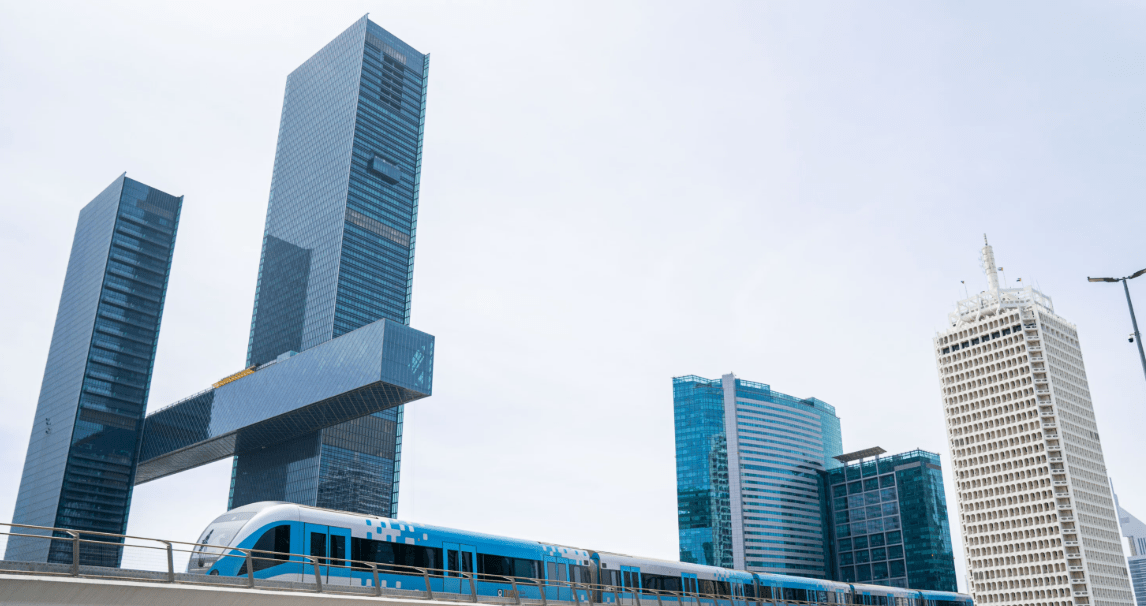
Dubai Metro accounted for the largest share of total ridership in H1 2026, carrying 136.5 million passengers and representing 39.2 per cent of all public transport journeys. Taxis followed at 25.5 per cent with 88.9 million passengers, and public buses at 24.4 per cent with 85.1 million passengers. Together these three modes accounted for nearly 89 per cent of all trips, confirming the Metro as the backbone of Dubai’s public transport system and setting the baseline from which the next wave of expansion will operate.
That next wave is already under construction. The Dubai Metro Gold Line, a 42-kilometre fully underground route with 18 stations and an estimated cost of AED 34 billion, will connect with both the Red and Green lines and with Etihad Rail, extending the Metro’s reach significantly into areas of the city that currently depend on buses and private cars. The Blue Line, a 30-kilometre route with 14 stations serving nine key districts with a combined population of around one million residents, is progressing in line with the Dubai 2040 Urban Master Plan. And the RTA has begun phased operation of 637 new Euro 6 buses, including 40 electric vehicles that represent the largest deployment of electric buses in UAE history.
Driverless Taxis and Air Taxis by End of 2026
The most headline-grabbing element of the RTA’s H1 2026 announcement was not the 348 million passenger figure. It was the confirmation that driverless taxi operations began earlier in 2026 and that commercial air taxi services are being prepared for launch before the end of the year. Air taxis, which use electric vertical takeoff and landing aircraft to carry passengers between designated vertiports across the city, represent a category of urban mobility that no city in the world has yet deployed at commercial scale. Dubai is positioned to be the first. The infrastructure, the regulatory framework and the partnership with aircraft developers required to make that launch happen have been in development for years, and the RTA’s public confirmation that the commercial launch is on track for 2026 is the clearest signal yet that the timeline is real.
For businesses across Dubai’s real estate, hospitality, events and business travel sectors, the combination of expanded Metro infrastructure, electric buses, driverless taxis and commercial air taxis represents a fundamental change in the mobility options available to residents, visitors and employees. Properties near future Gold Line and Blue Line stations will benefit from connectivity premiums that are already beginning to be priced into the market. The air taxi network, once operational, will create entirely new accessibility dynamics across the city, reducing effective travel times between certain destinations dramatically and changing the value proposition of locations that are currently underserved by ground-based public transport.
“RTA began operating driverless taxis at the start of 2026 and is preparing to launch commercial air taxi services before the end of the year, while continuing to advance the Dubai Loop project. Dubai is positioning itself to be the first city in the world to offer commercial air taxi services at scale.”
— Mattar Al Tayer, Director General, RTA (Zawya, August 2026)