


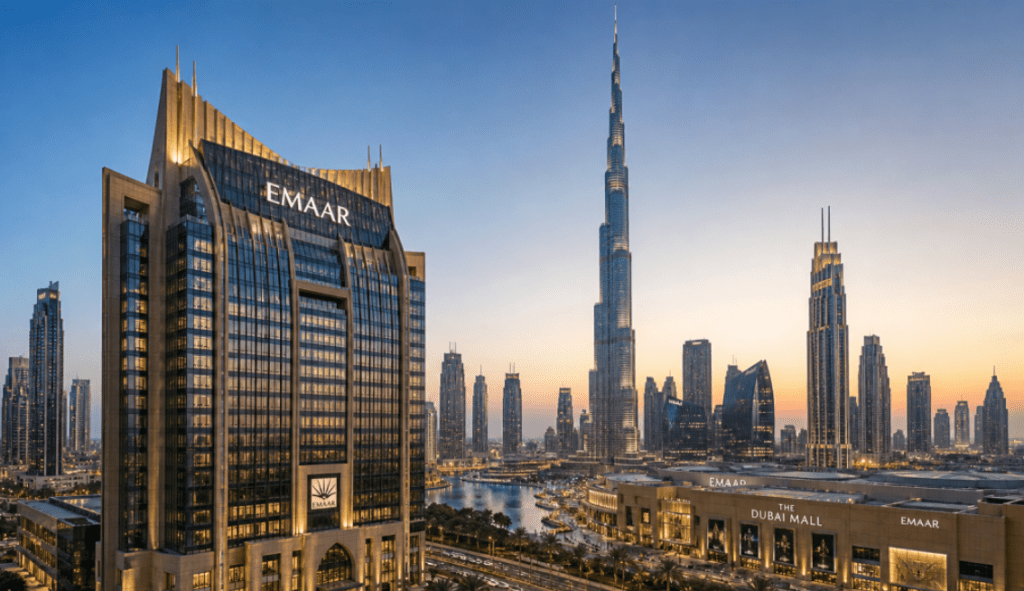
Emaar Properties recorded property sales of approximately AED 26.6 billion, equivalent to $7.2 billion, in the first half of 2026. Net profit before tax increased 23 per cent to AED 12.8 billion. Total revenue reached AED 23.9 billion, up 21 per cent year on year. The revenue backlog from property sales stood at AED 164.9 billion as of 30 June 2026, a 13 per cent increase year on year and one of the strongest forward revenue visibility figures the company has ever reported. These numbers, released today, are not just a corporate earnings announcement. They are the most reliable real-time signal available on the actual state of Dubai real estate demand, and they are pointing decisively in one direction.
Emaar is Dubai’s largest and most diversified property developer, operating across residential, retail, hospitality and commercial segments simultaneously. When Emaar posts AED 26.6 billion in property sales across a six-month period that included genuine regional geopolitical disruption, it tells you that buyer demand for Dubai real estate is not a fair-weather phenomenon. It is structural, sustained and sufficiently deep to absorb external shocks without the volume collapse that more fragile markets experience under similar conditions. The Dubai population rebound data released this week showed 157,000 net new residents added in H1 2026 despite 61,000 leaving in March, providing the demographic context that explains why Emaar’s sales held up: the underlying demand driver, people choosing to live in Dubai permanently, kept growing even through the most difficult months.
“Our performance in H1 2026 reflects the strength and resilience of the UAE economy, which continues to provide a stable foundation despite broader regional volatility. Geopolitical developments have reinforced the importance of operating in markets defined by safety, institutional continuity and long-term vision.”
— Mohamed Alabbar, Founder, Emaar Properties (Emaar H1 2026 Results, August 2026)
The AED 164.9 Billion Backlog That Defines Dubai’s Next Five Years
The revenue backlog is the figure that matters most for anyone trying to understand where Dubai real estate is heading over the next three to five years. A backlog of that scale, representing contracted sales that will convert to recognised revenue as projects complete and hand over, provides an extraordinary degree of earnings visibility for Emaar and for the entire supply chain that depends on its construction programme. It also tells you that the Dubai property market is not running on speculation or momentum alone. It is running on a pipeline of contracted demand that has been building systematically over multiple years and will continue generating economic activity and population growth as those units are delivered.
Emaar launched 11 targeted residential projects across its master-planned communities in H1 2026, spanning Emaar South, Dubai Hills Estate, The Heights Country Club, The Oasis, Rashid Yachts and Marina and Expo Living. That geographic and product diversity reflects a deliberate strategy to serve different buyer segments simultaneously rather than concentrating on any single price point or community. The international dimension of Emaar’s business also contributed meaningfully, with the group’s Egypt, India, Turkey and other international operations adding to total revenue and providing portfolio diversification that reduces dependence on any single market.
What These Results Mean for the Broader Dubai Property Market
Emaar’s H1 2026 performance sets a reference point for the market that benefits everyone operating within it. For buyers considering whether Dubai real estate represents a durable long-term investment, the AED 164.9 billion backlog is evidence that thousands of other buyers across the world have already made that calculation and committed capital at scale. For developers competing in the same market, the results confirm that demand exists at the volumes required to absorb the significant pipeline of residential units under construction across the emirate. For the financial institutions, property managers, interior designers, furniture retailers and the hundreds of other businesses in the real estate ecosystem, the Emaar numbers are a forward indicator of the activity levels they can expect to service as that backlog converts to completed homes over the coming years.
“Emaar’s revenue backlog from property sales reached approximately AED 164.9 billion as of 30 June 2026, reflecting a 13 per cent increase year on year and providing strong visibility for future revenue recognition across its master-planned communities in Dubai and internationally.”
— Emaar Properties, H1 2026 Financial Results (Zawya, August 2026)






Comments 1