Streamlined border operations, smart AI engines, and deep institutional integration drive record-breaking milestones across international trade indices.
The UAE has achieved a monumental breakthrough in international trade benchmarks, propelled by the transformative modernization of its national customs ecosystem. According to the 2026 Competitiveness Report evaluating 2025 performance metrics, agile customs procedures have emerged as a primary engine accelerating cross-border commerce, bolstering supply chain continuity, and elevating the nation’s standing on the global stage.
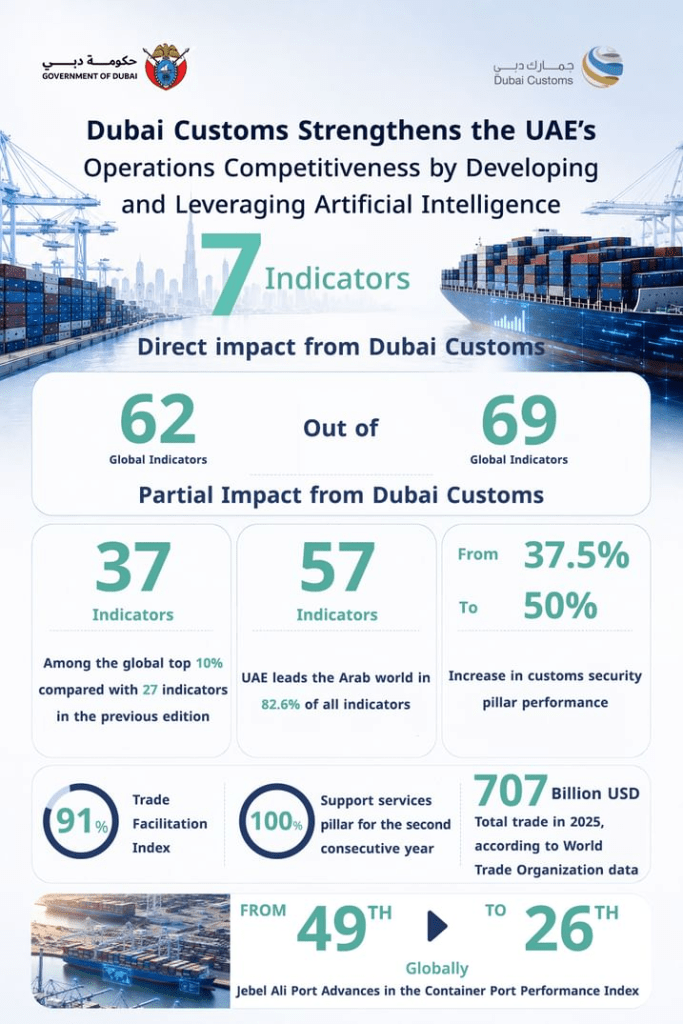
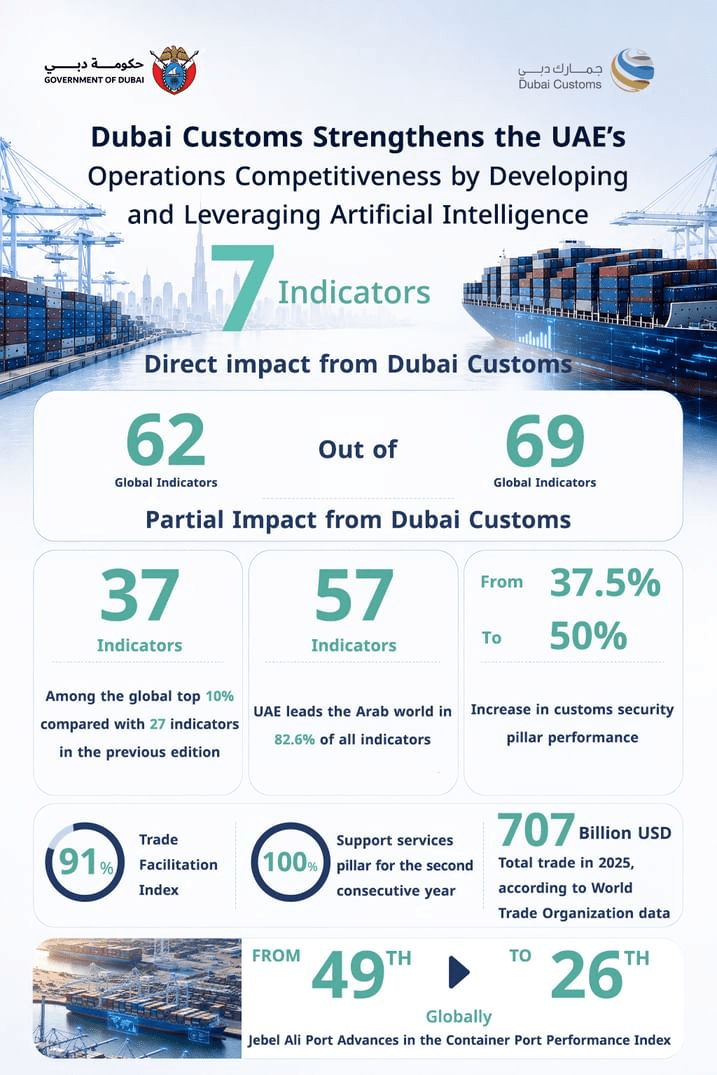
Drawing from 30 respected international reports and 69 distinct competitiveness indicators, including 10 newly introduced metrics, the latest evaluation captures an unprecedented institutional surge. The number of indicators where the UAE ranks within the top 10 percent globally climbed from 27 to 37, representing the largest single-edition leap on record. Regionally, the nation now leads the Arab world in 57 indicators, accounting for an impressive 82.6 percent of the total. Overall, the UAE improved or maintained its front-running position across 87 percent of all tracked metrics.
Direct Operational Impact on Global Logistics
At the core of this competitive ascent is the operational efficiency orchestrated by Dubai Customs. The department directly influences seven major international indicators, including four critical dimensions of the World Bank’s Logistics Performance Index (international shipments, tracking and tracing, timeliness, and the core customs sub-index). Its footprint further shapes the Global Innovation Index’s logistics services pillar, the Legatum Prosperity Index’s border administration metrics, and TRACIT’s cross-border trade framework.
Beyond direct indicators, the agency’s digital and security mechanisms partially impact 62 additional metrics, underscoring how deeply integrated border oversight is with the wider economy.
Highlighting this strategic evolution, Dr. Abdulla Busenad, Director General of Dubai Customs, explained:
“Dubai Customs plays a pivotal role as one of the key enablers of trade and the economy, through an integrated operating framework that goes beyond traditional oversight of goods movement, contributing effectively to supporting the competitiveness of the national economy and accelerating its sustainable growth.”
He further observed:
“The competitiveness index results reflect the growing reach of customs work beyond the indicators directly tied to customs performance, underscoring the link between the efficiency of procedures and the pace of trade, the quality of services, the resilience of supply chains, the appeal of the business environment, and the economy’s capacity to adapt to rapid global shifts.”
Cutting Bureaucracy Through Intelligent Systems
The tangible economic outcomes of these integrated logistics frameworks are evident. In 2025, the UAE ranked ninth globally in merchandise export trade, with total trade volume reaching $707 billion under World Trade Organization data. Concurrently, Jebel Ali Port advanced from 49th to 26th place globally on the Container Port Performance Index (CPPI).
A decisive factor behind these gains is the nationwide campaign to eliminate administrative friction, securing the UAE the number one global position on the Absence of Bureaucracy Index. Within the customs sphere, manual checkpoints have been systematically replaced by proactive digital ecosystems.
- The Shahin Platform: Connects maritime, air, and land stakeholders to slash transaction turnaround windows and accelerate cargo release.
- The Smart Risk Engine & ACI: Leverages predictive artificial intelligence and Advance Cargo Information to assess incoming freight before port arrival, concentrating physical inspections exclusively on high-risk consignments.
- The Green Corridor Initiative: Offers expedited processing lanes for verified, compliant commercial operators.
- The Mirsal Digital System: Facilitates instantaneous inquiries and provides real-time clearance visibility, maintaining the support services indicator at a perfect 100 percent for the second consecutive year.

Securing the Future of Global Trade
These integrated technology deployments drove the customs security pillar from 37.5 percent to 50 percent, a 12.5 percentage-point surge that stands as the single largest relative gain among all evaluated pillars. Meanwhile, the Trade Facilitation Index rose to 91.5 percent.
Investing in human capital remains equally fundamental. Through targeted initiatives such as the “Masar 33” leadership track, specialized talent is systematically trained in emerging technologies, advanced risk modeling, and international supply chain diplomacy.
Reaffirming the long-term vision, Dr. Abdulla Busenad stated:
“We will continue working to move from facilitating trade to empowering it, from delivering services to anticipating customer needs, and from managing risk to building a smart, agile customs system that supports sustainable economic growth and cements the UAE’s position as a leading global hub for business, logistics, and trade.”