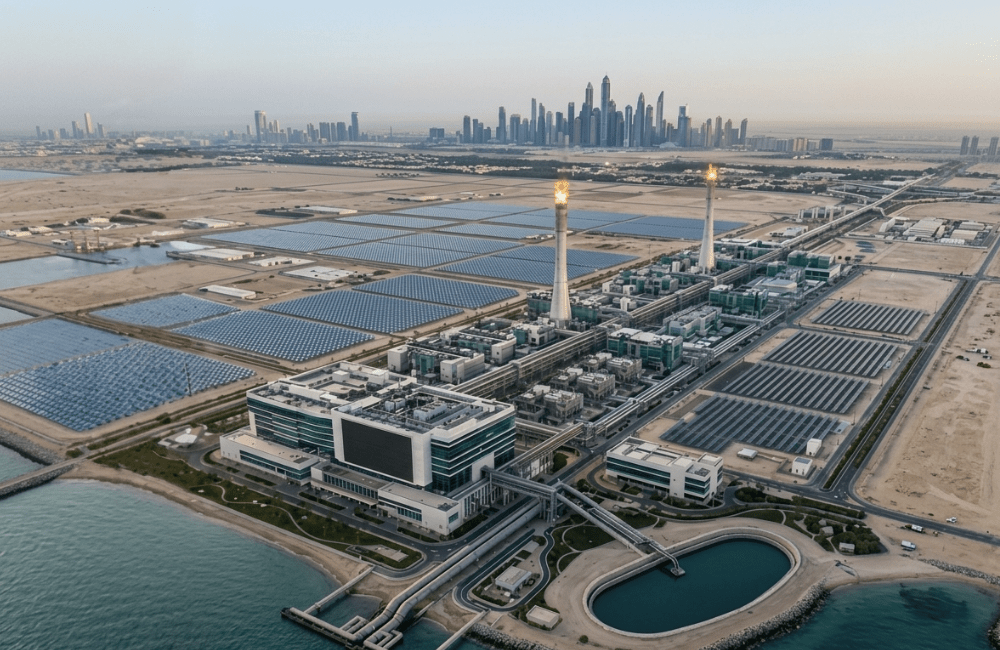
The UAE water crisis 2026 is not a future risk sitting on a government risk register somewhere. It is a present reality that the country has been managing, with significant investment and genuine engineering ingenuity, for decades. The UAE has one of the lowest natural freshwater endowments per capita in the world. It imports approximately 80 to 90 per cent of its food. It has a population and an economy that have grown at a pace that would have exhausted those limited natural water resources long ago without deliberate, sustained and expensive intervention. That intervention is well underway, and the infrastructure being built to secure the UAE’s water future is among the most technically sophisticated and commercially significant in the world right now. The UAE water crisis 2026 is real, but so is the response to it, and the response deserves as much attention as the problem.
To understand the scale of what has been built, consider that the UAE currently produces approximately 14 million cubic metres of desalinated water per day, making it one of the largest desalination operators in the world relative to its population size. It recycles approximately 90 per cent of its treated wastewater, one of the highest rates globally, using that recycled water for agricultural irrigation, district cooling systems and the green spaces that make the UAE’s cities liveable in an extreme climate. The National Water Security Strategy 2036 sets a target of producing 100 per cent of the country’s municipal water needs from sustainable sources. For a nation with the natural endowment of a desert, that is an extraordinary commitment, and the infrastructure required to deliver on it is being built right now across both emirates.
“By coupling the world’s cheapest solar electricity with advanced membrane desalination, the UAE is solving the energy-water nexus in a way that could become the model for arid regions globally.”
— Dii Desert Energy, MENA Energy Outlook 2026 (The Sustainable Times, January 2026)
The Solar Desalination Shift in UAE Water Crisis 2026
The most significant development in UAE water infrastructure in 2025 and 2026 is the accelerating integration of solar energy into desalination operations, and it matters because traditional desalination is enormously energy-intensive. Running large-scale reverse osmosis or thermal desalination plants on grid electricity from fossil fuel sources is both expensive and environmentally counterproductive for a country that has committed to net zero by 2050. Solar-powered desalination resolves that tension. DEWA’s integration of Mohammed bin Rashid Al Maktoum Solar Park capacity into its desalination operations, and ADNOC and ADQ’s investment in advanced membrane technologies that reduce the energy required per cubic metre of output, are moving the UAE toward a model where water security and energy transition reinforce rather than contradict each other. Several pilot projects are now testing direct solar desalination, which uses solar thermal energy rather than electricity, eliminating the conversion losses of the grid-powered approach entirely. The economics of these systems are improving rapidly, and the UAE has both the solar resource and the institutional commitment to scale them.
Smart Water Management
Alongside the supply-side innovation, the UAE is deploying smart water management infrastructure that targets demand as systematically as supply. AI-powered leak detection systems are being rolled out across Abu Dhabi’s water distribution network, identifying and flagging losses that would previously have gone undetected for months. Smart meters are giving residents and businesses real-time consumption data, creating the transparency that changes behaviour far more effectively than awareness campaigns alone. Tiered pricing structures incentivise conservation without penalising low-income users. And the agricultural sector, which accounts for a significant share of total water consumption across the country, is being progressively converted to precision irrigation and controlled-environment agriculture that uses a fraction of the water required by traditional open-field farming.
The UAE water crisis 2026 is being addressed on both sides of the equation simultaneously, reducing the demand that the system must meet while expanding the sustainable supply available to meet it. For any business operating in the UAE, water efficiency is no longer a corporate social responsibility consideration. It is a strategic and increasingly commercial priority as pricing and regulatory pressure on consumption intensifies over the coming years. For the technology companies building desalination innovation, membrane technology, water recycling systems and smart monitoring infrastructure, the UAE is one of the most commercially attractive deployment environments in the world, with the budget to pay for solutions that work, the willingness to pilot at scale, and the ambition to export what works to the water-stressed regions that will need it most in the decades ahead.