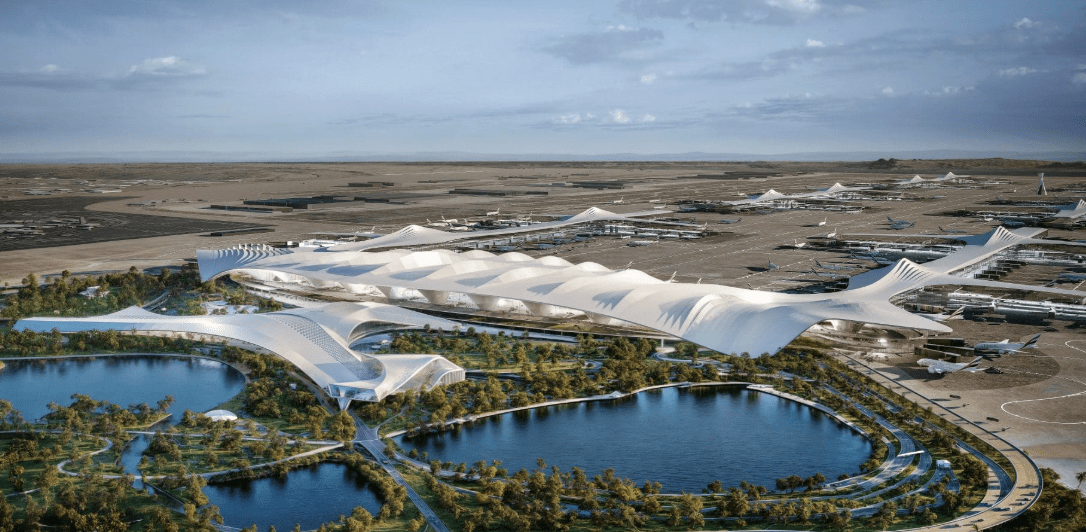

From DXB to DWC is more than a change of airport code. It is the most significant aviation infrastructure transition any city has attempted in the modern era, and it is no longer a plan on paper or a vision document on a government website. The AED 128 billion expansion of Al Maktoum International Airport at Dubai World Central began full-scale construction in early 2026, and what is being built is genuinely without precedent. Five parallel runways. Up to 400 gates. Capacity for 260 million passengers annually when the full project is complete, making it the largest airport in the world by a significant margin and nearly three times the capacity of Dubai International at its operational peak.
Dubai International Airport handled 95.2 million passengers in 2025, the highest figure in its history and a record that confirmed its continued status as the world’s busiest international airport. But that record also carries a warning. On current growth trajectories, DXB will approach its operational ceiling before the end of the decade. Infrastructure at that scale cannot be expanded indefinitely within an urban environment that has grown up around it over decades. Without DWC coming online at the right moment, Dubai’s aviation capacity becomes a constraint on the entire economy, on tourism numbers, trade volumes, real estate demand and the continued attractiveness of the emirate to the international businesses and residents that have made it one of the world’s most dynamic cities. The from DXB to DWC transition is not an infrastructure upgrade. It is an economic necessity that has been planned for, and is now being delivered.
“There will come a point where we outgrow DXB, and in 2032, we must make that move to DWC. The DWC Al Maktoum International project is absolutely essential for our growth.”
— Paul Griffiths, CEO, Dubai Airports (Gulf News, Dubai Airshow 2025)
How Emirates Will Handle the DXB to DWC Transition
Sheikh Ahmed bin Saeed Al Maktoum, Chairman and CEO of Emirates, has been clear about how the world’s largest international airline will handle the move. It will happen in one go, not in phases. The terminal will be open and fully tested before the first Emirates flight departs from Al Maktoum, and when it does, the entire operation moves with it. That decision reflects a hard-won lesson from airport transitions elsewhere in the world, where phased migration creates split infrastructure costs, divided passenger flows and a confused experience that undermines confidence in both the airline and the destination. The clean break is harder to execute but produces a better outcome for everyone involved, and Emirates has the operational scale and the institutional experience to pull it off.
The timeline is 2032 for the first phase of DWC to be operational. That gives the construction programme six years from the start of full-scale building to handover, which is ambitious but credible given the infrastructure investment going in and the track record of major UAE construction programmes delivering at pace. For airlines, travel companies, airport retailers and the entire hospitality ecosystem that depends on international passenger flows through Dubai, the from DXB to DWC transition is the single most important infrastructure event on the horizon. The businesses that start planning for it now, rather than waiting until the move is imminent, will be the ones best positioned to capture the opportunities it creates.
“It will happen in one go. You will wake up one day with the terminal open and tested, and you will see your Emirates flights from Dubai Al Maktoum.”
— Sheikh Ahmed bin Saeed Al Maktoum, Chairman and CEO, Emirates (Arabian Travel Market, 2024)
What the Move Means for Dubai South and the Surrounding Area
The from DXB to DWC story is ultimately an economic development story as much as it is an aviation story, and the economic geography of Dubai is already being redrawn around DWC even before the airport reaches full capacity. Transactions in Dubai South exceeded AED 15 billion in the first five months of 2025 alone, nearly matching the full year figure for 2024. Rents in the area rose approximately 20 per cent year on year. Communities, logistics hubs, warehousing facilities and commercial zones are all being developed with a 260 million passenger catchment in mind, a catchment that does not yet fully exist but is coming with a degree of certainty that very few infrastructure investments in the world can claim. DWC will also connect to Etihad Rail’s high-speed network, making Abu Dhabi 30 minutes away by train from the new airport and fundamentally changing the connectivity between the two emirates for the millions of people who move between them for work, leisure and business every year. For investors, developers and business leaders watching where the next wave of Dubai growth is concentrated, the answer is increasingly clear. It is in the communities, the commercial districts and the logistics infrastructure being built around Al Maktoum International right now, years before the first commercial flight departs from its runways.